Sunday, April 01, 2007

Andrew Pixley

Andrew Pixley, apparently a "TV historian", is quite happy to hype the 1970s, as we all know.

In his work on the background to playwright Alan Plater, for Network DVD (who also hype the 70s to death), Mr Pixley claims that a one-off play in October 1969, The Coalhouse Door, was shown "as the 1970s arrived".

Strange.

I'm sorry, Mr Pixley, but October 1969 did not mark the arrival of the 1970s.

One is led to assume that the apparently drudgy 1960s were giving way to the apparently grand epoch that was the 1970s, and the 70s were somehow foreshadowed.

Nonsense.

For the serious researcher, the 1970s are simply a set of numbers. The decade arrives at the beginning of 1970 and leaves at the end of 1979. That's it.

Many people see 1969 as the culmination of the events of the swinging 60s, not as the start of the financially restrictive 70s, but, whatever - that is of no consequence to the professional researcher. If a one-off play is shown in October 1969 the glory or otherwise may influence but does not belong to the following decade.

If Softly Softly became Softly Softly Taskforce in 1969, that's just when it should be reported as happening. There is no "70" in the digits 1969!

Shame that many "factual" writers allow a bizarre 70s fixation to get in the way of producing good, clear work.

I'm tired of reading inappropriate mentions of the 1970s from thumb-sucking geeks, most of whom barely remember the decade.

Andrew Pixley please take note.
-
-
An e-mail from Greg, Warrington:
-

Andrew Pixley is a major embarrassment. Some of his research is good, but he is very much one of the new breed of self styled experts, complete with bizarre retro waistcoats, 1970s obsession, and an ego the size of Lancashire.

He has managed to contribute an awful lot to the mystifying glorification of the 1970s so much in vogue and a pile of fact-based misinformation, too. Read his work by all means, but do not take it to be definitive.

Saturday, February 17, 2007

Wikipedia - "Crap Wrapped In A Computer"

I've been having another browse through Wikipedia, and I must say it doesn't improve. Things seem worse than ever: lies and nonsense, aimed at glorifying the 1970s, abound - and why are so many things from the 1980s listed as "70s" or "90s"?

Elsewhere, Wikipedia is really dire, too.

The concept has proven itself unworkable.

Too many agendas, too much ignorance posing as knowledge.

I can't quote things from Wikipedia as they are liable to change within minutes, but don't trust it folks.

The title of this post is a quote from the World Wide Web.

Accurate, I'm sure you'll agree.

Unlike Wiki.

Thursday, November 09, 2006

Friends Reunited - More 70s Misinformation...

Reading through the Friends Reunited year-by-year account of what we were doing in the 70s, I can't help seeing the flaws.

Here's one I've picked out for you:

"1978: We were playing Space Invaders." We were not. They were just being invented in Japan and would not even be previewed at a UK trade show until 1979! The Invaders were everywhere in the early 1980s.

I don't want to be too hard on Friends Reunited, but shouldn't they try and get things right if they're going to undertake year-by-year rundowns of our leisure activities?

Of course, Pac-Man (1980), the invention of the World Wide Web (1989) and numerous other 80s events were missing from the 1980s section.

More 70s hype!

Saturday, October 07, 2006

The Spacehopper - Released In Britain In The Late 1960s, NOT The 1970s...

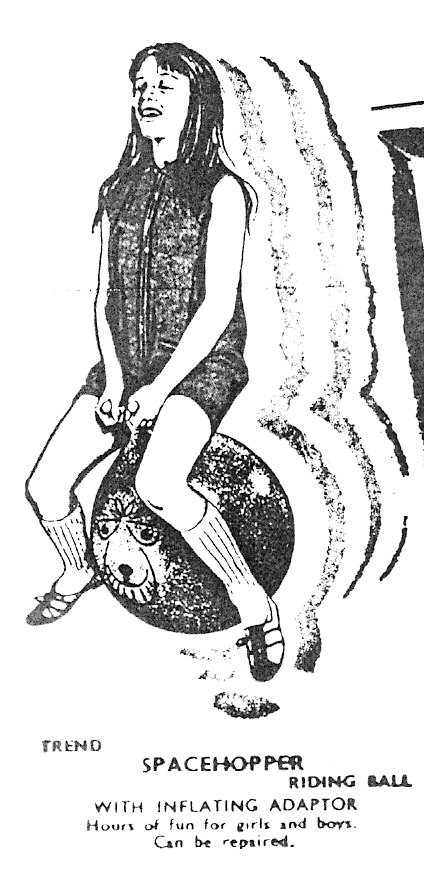
Here is part of a newspaper advertisement showing a girl on a space hopper...


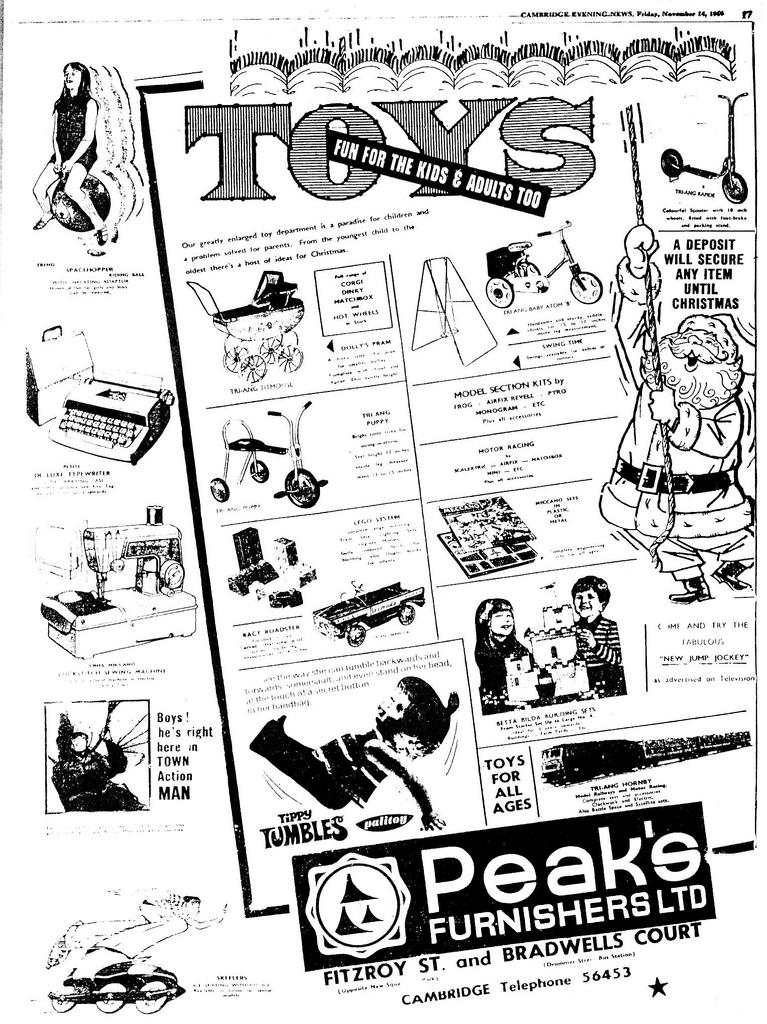
... here is the whole advertisement...


... and here is the date - Nov 14th, 1969. For the I Love 1970s series, a small caption was inserted in the opening titles, stating that the space hopper was released in 1968 and then "bounced its way through the 70s". Fair enough, but the I Love... website states that the first spacehoppers arrived in this country in 1971. Would you like onions with your tripe?

The spacehopper was an instant hit, very popular from 1968 onwards. It was still going strong in the '70s, yes, but did it really deserve such major billing? Other sites follow the BBC's line, touting the hopper as either new in 1971 or as THE craze of 1971. Popular, yes. New or a sudden craze? Most certainly not.

A willing victim of the BBC's misinformation is the Toy Retailers Association, formerly the British Association of Toy Retailers. Their website informs us that the Space Hopper arrived in 1971 and was "Craze of the Year". But unfortunately, the Association NEVER had a "Craze of the Year" award, and media of 1971 reveals that the Hopper was certainly not newsworthy.

Oddly enough, in the late 1990s, the Toy Retailers Association were listing: "Clackers, otherwise known as Klik Klaks" as the "overwhelming toy mania of 1971".

That information is accurate. So, why hype the spacehopper out of the 1960s and into the 1970s now?

I believe this muddling of facts is due to the BBC having an agenda to hype the 70s in the I love 1970s series.

There is also the fact that people who were children in the 1970s are often pulling the strings now, and the Internet provides a tremendous opportunity for the spreading of untruths and building up or knocking down of various eras. When you consider that the World Wide Web was only invented in 1989, and Internet use has blossomed incredibly since then, you can see the difficulties. Anybody can publish anything on the Web - and, as well as great sites, there are many which tell untruths for their own ends.

Many people invest much time in hyping the 70s - those who want to feel good about their youth, and those young geeks and nerds who do not remember the 70s, but have no present and enjoy "living" in a nice, safe fantasy past.

It is sad and silly.

But the spacehopper did not arrive in this country in 1971, or indeed in the 1970s at all.

And that's a fact.

Friday, August 18, 2006

BBC On This Day - Brighton Nudist Beach, 1980 - NOT 1979

The "We're always right" attitude of the BBC and the Corporation's 70s fixation has been causing one reader a few problems.

My sister-in-law Deborah has been in touch to tell me of a sorry tale involving Brighton Nudist Beach, and Alison Trowsdale and Hanna White, two BBC employees committed to the old maxim "the customer is always wrong".

Deborah is a researcher who specialises in recent pop culture, and was surprised to read on the BBC's "On This Day" site: "August 1979 - Brighton Bares All". There followed an article about Brighton nudist beach, which opened in April 1980. The article referred to a decision made in 1979 to give the beach the go-ahead, but the "Brighton Bares All" title rather suggested that the beach opened in '79 and the only reference to the 1980 opening date was tucked away under a heading entitled "In Context". Odd.

Some months later, Deborah bought a birthday card for a young relative, born in 1979. It featured so-called events of 1979 - a "Year You Were Born" theme card - and announced: "Britain's first nudist beach opened in Brighton". Intrigued, Deborah phoned the manufacturers.

"But it must be true!" she was told: "The BBC says so - August 1979, on this day, 'Brighton Bares All'!" Further investigation proved that the BBC's On This Day article had led quite a lot of others up the garden path. Surely it made more sense to commemorate the anniversary of the beach's opening day - 1st April 1980?

But the BBC doesn't like the 1980s. Bizarrely, a BBC Oxford online article, this time about the World Wide Web, touts 1990 as the pivotal year - and the trivial fact that the web was invented in 1989 is tucked away in the small print!

Anyway Deborah wrote to the BBC about the Brighton nudist beach...

Ridiculous article - it gives the impression that the beach opened in August 1979. There was no nudity on that beach until the opening day in 1980. The BBC really needs to get over its 70s fixation.

And BBC employee Alison Trowsdale replied:

The report "Brighton bares all" was written to coincide with the date the local authority made the decision to designate part of Brighton beach for nudists. It clearly states that the beach officially opened 1 April 1980.

"Officially" opened? Actually, the beach "opened" on 1 April 1980. Deborah wrote again, reasoning:

The Brighton nudists' beach article is headed "August 1979 - Brighton Bares All" and only states some way in that the beach officially opened on 1st April 1980. It did not OFFICIALLY open on 1st April 1980, it OPENED on 1st April 1980 - I was there.

The article is, I'm afraid, misleading and has led to inaccurate information appearing on several websites and a range of "Year You Were Born" greetings cards - all stating that the beach opened in 1979. I have made enquiries, and the BBC has been cited as the source of information on each and every occasion.

Brighton and Hove Council's article on the beach does not even mention 1979...

"On This Day" for 1st April contains no mention of the beach's big opening in 1980.

I do wish that you would not reject my complaint out of hand. The BBC is supposed to serve, not press its bizarre 1970s obsessed view of the past on to the general public. We had quite enough of the warped view with the "I Love 1970s" TV series.

No answer came the stern reply. Deborah wrote again and received this reply from one Hanna White:

Dear Mr [Mr?! Wonderful attention to detail, but then it is only a member of the public]
xxxx,

Your latest email to On This Day is not being ignored at all. Alison Trowsdale works part-time for the BBC and is not currently at work.

Her initial response to you was not dismissive but sought to point out that all the facts of the story were there to be read.

However we have decided to changed one word in the first paragraph of the article from "has" to "will" for greater clarification.

Regards

Hanna White

Finally Deborah decided to make a formal complaint.

This was a trivial matter. Deborah had evidence that the article had led to confusion. But the BBC dug its heels in and conceded only to the point of making a grudging, tiny, alteration to the article. The article is still open to misinterpretation. Web surfers are notorious for skimming - we do it ourselves!

BBC information should be clear. The article should be dated 1 April 1980, beginning with the tale of the beach's opening day, and then telling the background story.

Deborah has recently suffered two bereavements, and has handed over the reins to myself and the
80s Actual group. We think it is best to publicise the BBC's attitude - and, although this is a trivial incident, we think it is important. It indicates the BBC's attitude to the public, and also its ridiculous attempts to glorify the 1970s.

We shall be monitoring!

Friday, July 28, 2006

The Shake n Vac TV Ad - 1980s NOT 1979

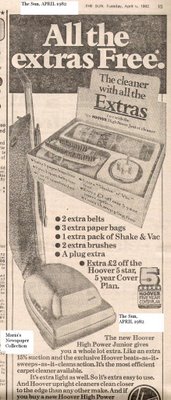
I have an extensive collection of newspapers, and access to an archive dating back to the nineteenth century. The first reference to Shake n' Vac I've found dates to 1982, when it was a free gift with the new Hoover High Power Junior vacuum cleaner. I am absolutely convinced that the Shake n' Vac ad is later than 1979, and finds like this do nothing to sway my conviction.

Hello, good evening and welcome! Tonight we're going to look at the serious issue of hyping the 1970s. The 1980s, we have decided, are total baddies - full of greed and yuppies. From the first second of 1980 to the last second of 1989 everything was about looking after Number One. The 1960s were total goodies, but they have been overdone. So we must sell the 70s. How do we do it? Well, if something judged by many to be good - a TV programme, toy, fashion, record, etc, came out in the late 1960s, then we'll call it "1970". If a similar item came out in the early (or even mid) 1980s, we'll call it "1979".

1979 is terribly successful - already cropping up an awful lot where it shouldn't, eating up 1980s pop culture faster than Pac-Man ever could. Let's take an example. In the early-to-mid 1980s, there came into being a terrible television advertisement for a product called Shake n Vac carpet freshener. Lord knows when the product itself was launched, the earliest newspaper advertisements I can find date to 1982 when a packet was being given away free with each new Hoover Junior vacuum cleaner purchased.

Free giveaways such as this were a popular gambit with NEW PRODUCTS.


I'm not saying that the Shake n' Vac ad began in 1982 - I suspect it was a little later. I'm not even suggesting that Shake n' Vac itself was launched in 1982. All I am saying is that the famous TV ad was definitely later than 1979.

In the ad, a woman called Jenny Logan, playing a highly intelligent housewife, sang a retro rock n roll (1950s) style jingle, and did a '50s dance, whilst de-ponging her carpet. In the Year 2000, this advertisement was arousing nostalgic twinges. But it began in the early-to-mid-1980s! Oh dear, that will never do - call it "1979"! Yes, that's it! So, in a Channel Four programme called 100 Greatest British TV Ads, the advert, which came 19th, was listed as "1979". It worked a treat.

The Internet buzzed as young 1970s fantasists marvelled at this newly discovered item of "70s" pop culture. Andrew Collins, who was born in 1965 and perhaps should know better, edited the Friends Reunited book, and, it seemed, simply couldn't wait to list Shake n Vac as a "1970s Television advertisement". I'm not sure how Jenny Logan, the ad's star, viewed all this, but nobody else gave a damn so another piece of non-1970s pop culture was added to that decade by 1970s hype-ists. You can still view the ad on the internet today, marked "1979", together with a companion ad from 1988, implying that the campaign ran, on-and-off, for at least nine years. It didn't. We couldn't have stood it.

It all left me pondering over Box Of Delights - a book by TV writer Hilary Kingsley, published in 1989, which states that the Shake n Vac ad began in 1985. Each telly year covered in the book (from the birth of ITV in 1955 to the book's publication year, 1989) contains a "Commercial Break" section, and I quote from 1985:

... an inane housewife cavorted around the lounge doing the Shake 'n' Vac. Was that what Emmeline Pankhurst fought for?

Actually, I hadn't long moved house when the ad campaign started and that move took place around 1982/83.

So another sucessful coup for the 1970s hypers. And not a mention of power cuts, the Winter of Discontent, the 1979 playground shootings (which led to the Boomtown Rats' chilling hit I Don't Like Mondays) or the 1979 ITV strike, which knocked the channel off the air for 11 weeks. In fact not a mention of anything that was, in reality, 1970s. It's all terribly simple...
-
BIG UPDATE!
-
Well, as it turns out the ad was first shown earlier than I originally contended, but in the 1980s, not 1979 - 1980, to be precise. The product was launched in 1979, but advertising delayed until 1980 due to the ITV strike of 1979. So, there we have it. At last!
-
The information comes from the World Advertising Research Center site, which contains a great deal of detail from "back in the day". Here's their Shake n' Vac info:
-
1.
Shake n' Vac: A New Product Launch
Hilary Rose, Mike Stefan and Carol Reay, Institute of Practitioners in Advertising, IPA Effectiveness Awards, 1980

Launch of a new powder carpet and room freshener. Sold in 1979, but advertising delayed to 1980 by ITV strike. TV only used. Results: consistent sales growth (Nielsen Food Index); sales growth linked to advertising; awareness, brand recall, levels of trial, all satisfactory. Regional variations on ad weight relate positively to sales and share (Nielsen). Contribution to profit and overheads in first year claimed, though not substantiated.
-
So, there we are. I wasn't absolutely right. Hilary Kingsley wasn't at all right. And neither were the 70s hypers. Considering that everybody from Friends Reunited to ITV itself have claimed that this ad debuted in 1979, I wonder why pop culture researchers can't seem to do research? Or is a determination to hype the 70s the reason?
-
Read the full info here.

Thursday, July 27, 2006

Wikipedia - Inaccurate 1970's Information

I've never really understood the idea behind Wikipedia. It's an online encyclopedia that anybody can contribute to at the drop of a hat, so facts seem to alter daily, but although it is, no doubt, monitored, it is massively guilty of 1970s hype.

I fear that 1970s revivalist geeks and nerds are rewriting the decade for Wikipedia, just like the researchers for the BBC's I Love 1970s and channel 5's That Was The Decade That Was series did for television in Britain.

Suddenly, the 1960s, a genuine era of rapid change, are unimportant.

Whilst stating that events are often wrongly attributed to the 1960s, Wikipedia then goes and does exactly the same thing with the 1970s. I certainly don't remember the feminist thing being the "be all and end all" of the 70s. It began in the 1960s (indeed media from that era suggests that it was very well advanced before the end of the decade), and was just as prevalent in the 1980s as in the 70s.

Gay rights? True, there were developments there in the 1970s, but the intial impetus came from the 1960s (homosexual acts between consenting adults in private were legalised in England and Wales in 1967) and the developments continued into the 80s and 90s and, indeed, beyond. The impact of AIDS, once touted as a "gay plague", had a huge impact on gay rights campaigns.

According to Wikipedia, everything of import happened in the 1970s.

The UK TV section refers to "innocent" 70s sitcoms. I remember an awful lot of smut. Isn't rosy coloured emotionalism clouding objectivity?

The Wikipedia 1970s section is HUGE, compared to its miniscule 1960s section. How this can be justified, I really cannot begin to imagine.

But then I do not understand the idea behind an online encyclopedia where anybody can write anything anyway.

The "let's glorify the 70s" ethos spills over into Wiki's accounts of adjacent decades and other sections, giving a unique and totally inaccurate account of the importance of the 1970s as a 20th Century decade. What is written is very similar to the (perhaps sometimes rather over-the-top) accounts of the glories of the 1960s in the media of the 1970s and 1980s.

Except that the 1960s were genuinely worthy of note.

There is something extremely amateurish about the 70s hype allowed on Wikipedia. One can smell the reasoning behind a lot of the waffle...

I write good things about the 1970s because it was my youthful era and my generation are special!

I write good things about the 1970s because I'm a nerd with no life in the current day.

If Wiki's 1970s information is anything to go by, then I certainly wouldn't use the site for research purposes. It is simply not of a standard professional enough to be trustworthy.

In fact I can only recommend that serious researchers avoid Wikipedia - or take the whole thing with a large pinch of salt.

Friday, April 07, 2006

1969? Call it 1970!

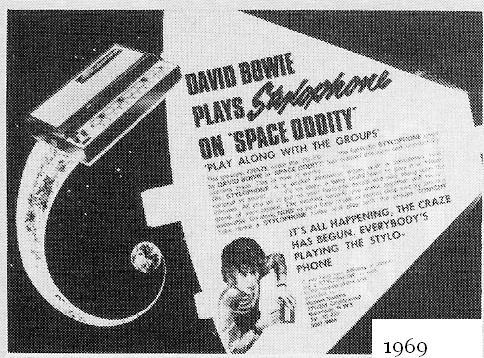
Ooh that's so 1970s! Not. Oddly enough, I don't recall a huge WOW about Stylophones in the 70s, and this ad is actually from 1969 when Stylophones were being sold as "the greatest craze since the yo yo". Yes, 1969. Not 1970.

Could you play David Bowie's Space Oddity on a Stylophone?

Thursday, April 06, 2006

EBay Buyers - Beware Of 70s hype!

Many eBay sellers have been cuckolded by 70s hype and some, perhaps, are simply dishonest - attempting to sell items as "1970s" when they are not. Chances are, if you have a fairly modern clonking great piece of technology it will have been produced in the 1980s or perhaps even the early 1990s. But some eBay sellers will list these items as "70s" - although they simply didn't exist back then or were only on the drawing board.

Watch yourself if buying "70s" items on eBay. It isn't just "70s" technology such as phones etc that are far more likely to be 1980s. Even some licensed TV and advertising characters often crop up as "70s".

Recently I spotted a badge from a well known TV advertising campaign, featuring a character invented in 1982, but listed as "70s".

Be warned...

And sellers - if you do not know when an item was produced, without any doubt, do not pretend that you do.

Sunday, August 28, 2005

The BBC Hypes The 1970s and Youngsters Lap It Up!

The BBC series I Love The 1970s should really have been called I Love 1967 to 1982. Apparently reflecting the pop culture of each 70s year, the things we were "into", the series was often wildly inaccurate, pumping in pop culture from the adjacent decades. I Hype The 1970s would have been a better title. For instance, the Lava Lamp, released in 1964, was featured as a major 70s icon. The reality was that the thing was at the height of its popularity c. 1968/69. In the early 70s, the lamp became deeply naff - so naff Stan and Hilda Ogden in Coronation Street acquired one and proudly placed it on their serving hatch! There was something of a revival midway through the decade, in a post modern tongue-in-cheek style, as Mildred Roper acquired one in the ITV sitcom George & Mildred. But never was the Lava Lamp "cool and cutting edge" in the 70s.

CB radio was featured as THE craze of 1976. It wasn't legal, and not available in England. This American 1940s invention began to arrive here in any appreciable numbers c 1979. Illegal breakers rose steeply in numbers in 1980 and, after a mass rally in London, the date for the legalisation of CB radio was set for the 2nd of November 1981, with the American inventor of the gadget, Al Gross, making the first legal call from a Rolls Royce parked in Trafalgar Square. But the BBC vaunted it as THE craze of 1976. In reality there was simply some interest in the terminology and the beginnings of a campaign to get it legalised here because of a hit record and a couple of American films!

The Space Hopper was popular in the 70s, but had been so since 1968; the Stylophone was released in the late 1960s.

In addition, the I Love The 1970s series boldly stole from the 1980s. Of course, some 80s arrivals were invented in the 70s - time is a constant stream and this is how things are with all decades. But the Walkman (invented in 1979) did not arrive here until 1980 (as the Sony Stowaway) and there were several other items, some unnamed and unmanufactured until the 1980s, wrongly sparkling away as 1970s pop culture in I Love The 1970s.

I don't hate the 70s, but surely it's better not to live a lie about them? I have an uneasy feeling that many of today's youngsters have bought the hype and have a very unrealistic view of the recent past. The fact that they might try and live out a fictional 70s, rather than living in the current day, worries me. Virtual reality lives - a virtual 70s which really never existed in the first place. For some years now, I've been hoping to find a Tardis, bundle our 70s loving kids into it, and sentence them to a week in the real 1970s. I could imagine the shock - where are the hippies? Why are there no personal computers? Why have the lights gone out? NOT paste sandwiches again! etc etc. But at least, on their return, today would seem more attractive to them.

There are things that need doing, issues which the young should be addressing. Stuff the fictitious 70s and get on with it, I say!

The 70s - Non Retro? So Modern? Oh Yeah?!

In the 1990s it became fashionable to look at the 70s as a golden era. Young people began living in a decade rewritten and repackaged by cynical marketing types and the BBC. Non greedy! Non retro! Lovely - peace and love all around! Let's look at the reality. Starting with "non-retro" - because the 1980s was the first "retro" decade, wasn't it? In reality, the 1970s matched it pound for pound! The putrid orange and brown colour schemes and platform shoes/wedges were lifted from the 1930s, and disco glitter balls were so 1920s/30s/Come Dancing. 1940s boutiques were a wow.

The 1950s permeated the music and fashion of the 1970s like nobody's business. There were drainpipes and DAs and 50s chords could be heard in pop music from Abba to Punk and beyond. We adored Alvin Stardust, Wizzard, The Rubettes, Showaddywaddy, Elton John, Darts - all of whom had torn pages from the 1950s image and song book. There were many others. At the flicks, we watched That'll Be The Day and Grease. The Rocky Horror Picture Show was in the retro style of a 1950s "B" movie. On Telly, we adored that 50s retro style icon, The Fonz.

The 1970s also adored the 1960s... In the absence of new ideas, the hippie look continued - though if you were to suggest to the majority of housing estate youngsters back in the 70s that they were hippies, you'd probably get a thick lip. Later in the decade, we scanned back further into the 1960s for a Mods & Rockers and Ska revival. The 70s even put Juke Box Jury, The Avengers, The Saint and The Rag Trade back on the telly.


The 1970s went a bundle on programmes about the Second World War - like the doomly A Family At War and Danger UXB. Past recessions were relived (why? The 70s had its own recession!) in Sam, The Stars Look Down and When The Boat Comes In. We ate Upstairs, Downstairs with a big spoon - and thrilled to Royal abdication drama Edward and Mrs Simpson.

Older retro TV was hot with Poldark and The Onedin Line.


In fashion, Victorian style mutton chop sideburns, puffed sleeved blouses and long dresses and smock tops were much in evidence. We stuck fibre glass wood effect beams to our ceilings and adored electric retro aga style stoves and plastic beaten copper effect tables. I have more to write on the 1970s love of retro, but now it's time for a cuppa and a nice Curly Wurly.

Retro Leanings 1971


1970s fantasists believe that the 1970s were a hugely creative, non-retro time. If that's the case, there are fairies at the bottom of my garden. This article from a Cambridge newspaper of December 1971 also paints a different picture. Click on image for closer view.

1979 was not 1985, and what about NOW?

It has been suggested to me that I am a little unkind to shatter people's delusions about the 1970s. Hey, celebrate the 1970s if you want to - we had a great time celebrating the 1950s and 1960s in the 70s, so I wish you the same joy.

The aim of this blog is simply to paint a more realistic picture of the 70s, to point out to people that 1979 was not 1985 and remind people that NOW exists and doesn't need to be based quite so heavily on retro yearnings for an era that wasn't all it's cracked up to be.

The 1970s have become an industry, and it doesn't matter whether the item in question is, in reality, 1967 or 1985 - label it "1970s", and you're on to a winner.

Wouldn't it be better to create some genuine NOW pop culture for 2005?

ITV Teletext hypes the 1970s!

I remember last year reading about the "heyday" of Top of the Pops on ITV's Teletext service. It was said to be, of course, in the 1970s - "viewing figures of up to 19.4 million".

Good heavens - when?! I wondered. A quick check of the TV ratings showed that Teletext was right - TOTP had 19.4 million viewers on one occasion in October 1979.

When the ITV strike was on and viewers had no other option but to watch the BBC!


And as BBC2 was a minority interest channel, guess what BBC channel we were all watching?

Yes, top prize is yours, we were all watching BBC1, home of TOTP!

In fact, BBC1 was the only other option - there was no Channel Four and no Sky back then.

But Teletext didn't mention the strike. Perhaps the article's writer was too young to remember it? Or perhaps it simply didn't go with 70s hype mode?

So, that was the (entirely imaginary) Top of the Pops 1970s heyday. I contacted Teletext, who removed the "heyday" comment, but, it must be said, grudgingly!

Did any decade ever undergo such a lot of tweaking and lies to make it seem enjoyable in retrospect as the 1970s? Was it the same when we were celebrating the 1950s back in the 70s? I doubt it. In one of the online "Off the Telly" reviews - subject the BBC's I Love... series, the reviewer states that the 80s were "a less enjoyable decade". Now, I'm no 80s fan, but bear in mind that this reviewer had just sat through I Love The 1970s, which had contained at least five items of 1980s pop culture! Things unheard of in the 70s, or completely unavailable, sparkling away as fads of that decade.

The 1960s were also raided.

The real 1970s were NOT a time of fast-moving fads. Pop culture moved much slower back then (look at the time we took to shake off the 1960s hippie look).

But people who weren't even there seem happy to believe the lies.

Wednesday, August 03, 2005

For the Love of the 1970s... Quote... Misquote...

On the wonderful web (invented by Tim Berners Lee in 1989 - quick, change that!) 70s hype-ists are so "into" boosting the decade, that they are quite happy to misquote people. Andy Allen of Central Television spoke on a programme called Crossroads - 30 Years On in 1994. This show was dedicated to the old-but-fondly-remembered ITV soap opera, Crossroads (1964-1988), home to wonderful Meg Richardson (Noele Gordon), lovely Shughie McFee (Angus Lennie) and dear Valerie Pollard (Heather Chasen).

Mr Allen stated in the 30 Years On broadcast that he believed the show had had its "great days", but was in decline when it was axed. Quoted on a Crossroads fan site, Mr Allen's words are added to - suddenly he believes that the show had had its great days "in the 1970s".

He certainly didn't say that in the broadcast, and there was no evidence of any editing.

Staying with the Crossroads Motel fan sites, it's worth noting information about Elaine Paige, who had a bit part in the King's Oak soap yonks ago. According to one fan site, she went on to great success in the musicals Cats and Chess "in the late 1970s".

In point of fact, Cats was 1981 and Chess appeared around 1985. Very "late 70s indeed". 19711 and 19715 if I'm not mistaken...

Can all these boo boos really be genuine mistakes? Or is my theory of 70s hype correct?

I've been studying the phenomena for long enough to know the answer... and perhaps you are beginning to wonder...